
If you look at the headlines coming out of Europe right now, you’d be forgiven for thinking the continent is a collection of bankrupt states occupied by protesting farmers and a right wing resurgence.
But if you look at the purchase orders, a different reality emerges.
While the rest of the world debates whether the survival of human society is “too expensive,” the European Union has committed to a 90% net emission reduction by 2040. And they are largely on target. This isn’t just a climate target. It is a geopolitical declaration of independence.
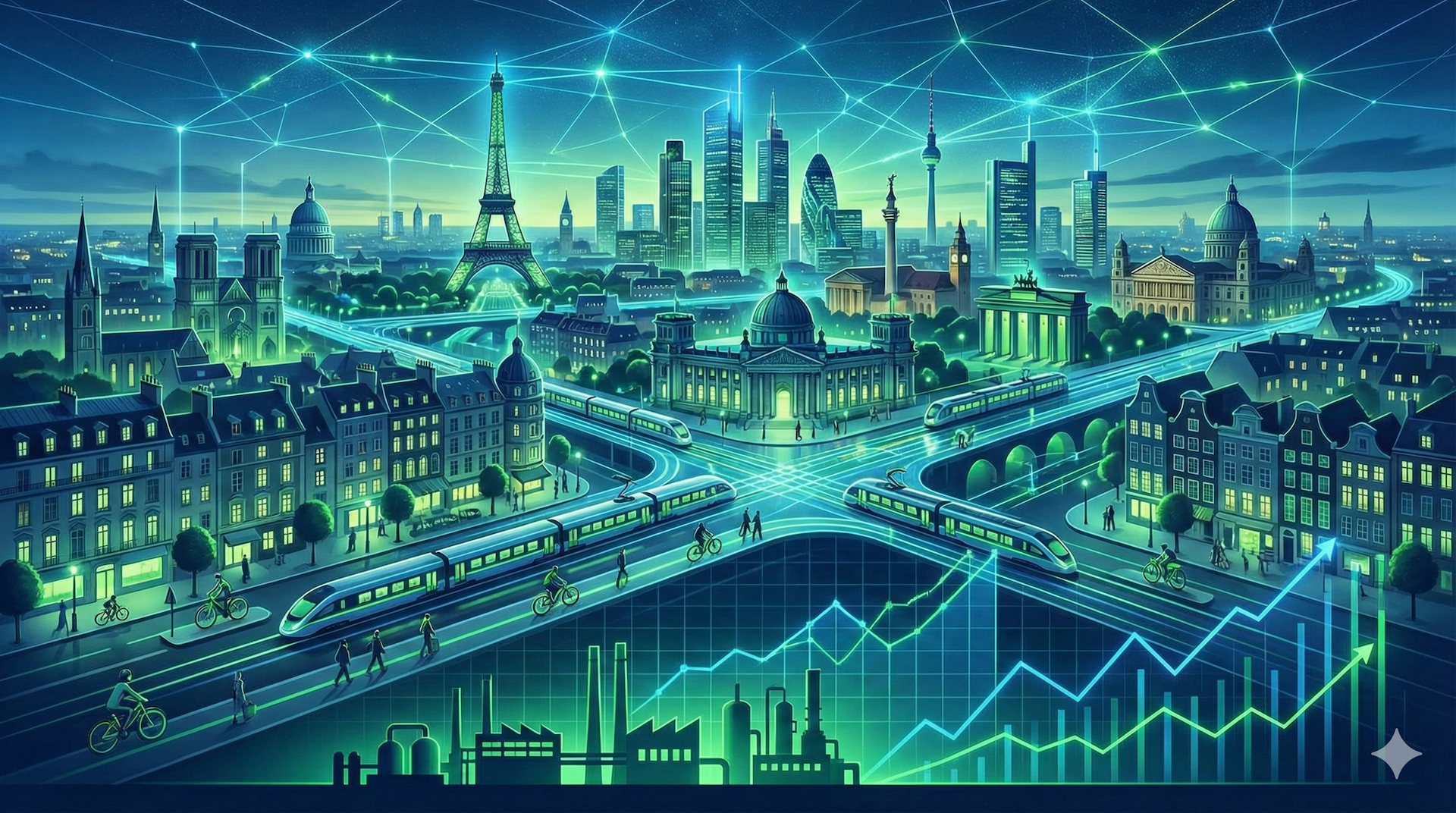
Europe is ending decades as a Petrostate customer—sending all of its dollars into Russia and the Middle East —and building an Electrostate.
For U.S. founders and investors, this distinction matters more than any quarterly earnings report. It’s about national security, industrial survival, and the single largest re-plumbing of an economy since the steam engine.
And unlike the AI gold rush in Silicon Valley—Europe is offering something different: state-backed de-risking for assets that exist in the physical world.
The “Moat”: Why Europe is a Safe Harbor for Real Tech
In the U.S., climate tech often feels like a casino game. VCs on Sand Hill Road are hunting for the next software unicorn that can scale to a billion users with zero marginal cost. While everyone else goes extinct.
Europe is playing a different game. They are building a fortress.
The cornerstone of this fortress is the Carbon Border Adjustment Mechanism (CBAM). Think of it as a firewall for the physical economy. “If you want to sell steel, cement, or fertilizer in the world’s largest single market, you play by our carbon rules. If you import dirty products, you pay a penalty.”
The Opportunities: What to Build
We aren’t talking about “apps” here. We are talking about the hardware and software that run a continent.
1. The Grid: The $22 Billion Arteries
An Electrostate runs on electrons, not molecules. But electrons are useless if you can’t move them. Europe’s grid is currently a bottleneck, and fixing it is an immediate market opportunity.
- The Market: The High-Voltage Direct Current (HVDC) market alone is projected to hit $22 billion by 2030.
- The Founder Play: Build Grid Enhancing Technologies (GETs). We need software that dynamically rates line capacity (allowing 30% more power through existing copper) and sensors that prevent outages. You are building the nervous system for the new grid.
- The Investor Play: This is pure infrastructure. Funding HVDC lines or long-duration storage isn’t a venture bet; it’s a yield play. You are financing the toll roads of the 21st century.
2. Heavy Industry: The “Hard Stuff”
Europe wants to keep making cars, planes, and buildings. It just can’t use coal to do it. The market for green steel and cement is shifting from “niche” to “standard.”
- The Market: The European green steel market is projected to explode from a tiny base today to over $64 billion by 2032.
- The Founder Play: Better chemistry. If you can produce cement clinker without CO2, or reduce iron ore with hydrogen instead of coking coal, you have a guaranteed customer base that must buy from you to avoid carbon taxes.
- The Investor Play: These are CAPEX-heavy projects, but they are de-risked by the state . You aren’t funding R&D; you are funding the industrial rollout of proven chemistry.
3. Verification: The “Truth” Layer
You can’t tax carbon if you can’t measure it. As Scope 3 rules tighten, “estimating” emissions is no longer legally defensible.
- The Market: The global carbon accounting software market is forecast to rocket to $100 billion by 2032.
- The Founder Play: Build the hard tech—satellites, methane sensors, and immutable supply chain ledgers—that provides primary data.
- The Investor Play: This is the SaaS layer of the transition. It scales like software, but it has the stickiness of regulatory compliance. Once a company integrates your verification engine, they can’t rip it out without risking a fine.
The Capital Stack: How to Fund the Revolution
The biggest lie in climate finance is that “VC is the only game in town.” The EU capital stack is far more diverse.
For the Risk Takers: State-Backed VC
You don’t have to face the “Valley of Death” alone. The European Investment Bank (EIB) has set a signature target of €86 billion for 2024 alone, specifically targeting climate action and innovation. The EIB is taking the first-loss position to crowd you in.
For the “Patient Capital”: Family Offices & Private Wealth
Not everyone wants to chase 100x returns on unproven models. Families like the Mulliez clan (Creadev) or the Brenninkmeijers (COFRA) are playing a different game: Generational Resilience.
The Opportunity? Infrastructure and Food Security. Family offices can deploy capital into retrofitting buildings or cold-chain logistics—assets that provide steady, inflation-hedged returns while securing the continent’s future.
For the Sovereigns & Institutions: The “Clean Industrial Deal”
The EU’s Innovation Fund—with a budget of €40 billion—is funded by the very carbon taxes polluters pay. It recycles wealth from the old economy directly into the new one.
For sovereign funds, this is a chance to deploy billions into projects that are essentially government-guaranteed. You are building the factories that will supply the Electrostate for the next 50 years.
The Bottom Line
The messy headlines are just the friction of a massive machine changing gears. Ignore the noise. Watch the signal.
Europe is betting its future on becoming an Electrostate. It is using policy to create a market, using tariffs to protect it, and using state banks to finance it.
You can stay in the casino, betting on the next ad-tech algorithm. Or you can look at the continent that just put a €1.5 trillion price tag on physics-respecting solutions and say:
“We’re in.”