
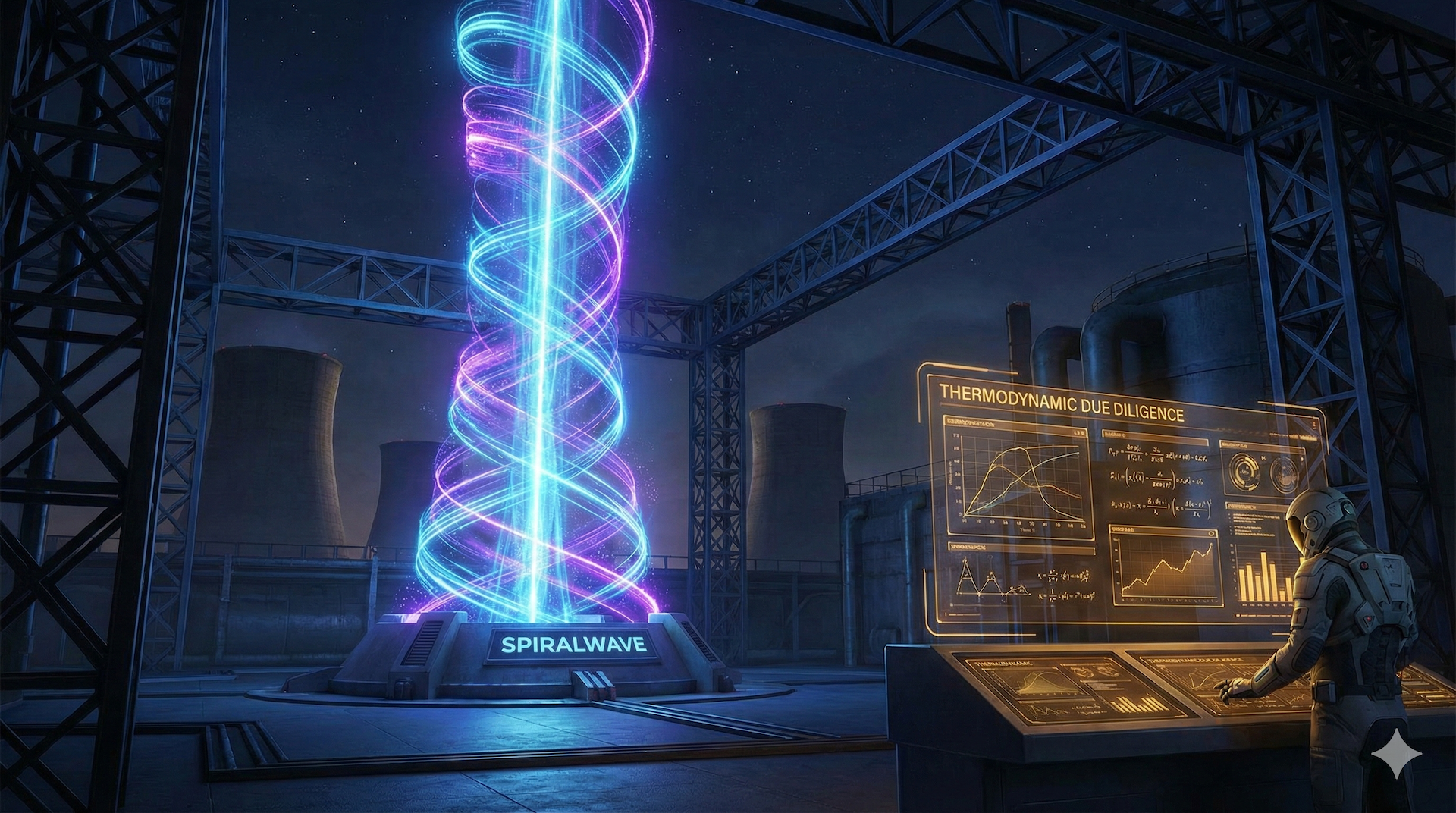
If you’ve ever looked at a standard carbon capture plant, you know they usually look like a chemical refinery designed by a brutalist architect—miles of pipes, fans, and gray steel.
SpiralWave decided to go a different route. They built a glowing, pulsing, sci-fi totem pole that looks like it should be powering a starship in The Expanse.
It’s undeniable: It looks cool.
But as we know at Climate Response, “looking cool” is not a metric that fits on a balance sheet or reduces parts per million (PPM) of CO2.
So, let’s turn off the mood lighting and run the Thermodynamic Due Diligence.
The Math: Input vs. Output
SpiralWave claims their “Cold Plasma” towers can strip CO2 from the air (or a smokestack), mix it with water, and shatter the molecular bonds to reassemble them into methanol.
The headline claim? 90% electrical efficiency. According to reports from TechCrunch and their own IndieBio data, they can produce a ton of methanol for roughly 7,000 to 10,000 kWh of electricity, depending on if they are pulling from a smokestack (easy mode) or the air (hard mode).
Let’s see if that math holds water—or methanol.
| Metric | The Numbers |
| Input Energy (SpiralWave Claim) | 7,000 – 10,000 kWh (per ton of Methanol produced) |
| Output Energy (Methanol) | ~5,500 kWh (Lower Heating Value per ton) |
| Round Trip Efficiency (RTE) | 55% – 78% |
The Verdict:
If you put 10,000 kWh in and get 5,500 kWh out, you have a Round Trip Efficiency of 55%.
- Is this a Grid Battery? NO. A Lithium-ion battery has an RTE of >90%. If you use this to store grid power, you are burning nearly half your energy just to change its shape.
- Is this a Fuel? YES. 55-78% efficiency for a liquid fuel is actually game-changing. Green hydrogen usually struggles to hit these numbers once you factor in compression and transport losses.
The Reality Check: The “1% Solution”
Founders love to talk about “reversing climate change” and “scrubbing the sky.” Let’s apply the Global Response Scale Test.
Suppose we want to use SpiralWave’s tech to reduce atmospheric CO2 by just 1%.
- Total CO2 in Atmosphere: ~3,300 Gigatons (based on ~420ppm).
- 1% Removal Target: 33 Gigatons.
- The Chemistry: Converting CO2 to Methanol (CH3OH) requires a mass ratio of roughly 1.375 tons of CO2 to create 1 ton of Methanol.
- Methanol Produced: ~24 Gigatons.
- Energy Required: 24,000,000,000 tons * 10,000 kWh/ton = 240,000 TWh.
The Kicker:
According to Ember’s Global Electricity Review, the entire world—every power plant, wind farm, and solar panel on Earth combined—generated about 30,000 TWh in 2024.
To remove just 1% of atmospheric CO2 using this method, we would need to dedicate 800% of the entire planet’s electricity supply to running these plasma towers.
The Bullshit Detection
This brings us to the sharp line.
- The Bullshit: Any claim that this technology will “reverse” climate change or be a primary method for removing historical CO2. The thermodynamics make it an impossible energy sink. It is an expensive treadmill.
- The Reality: This is not a “Sky Vacuum.” It is a Fuel Switch.
The Actionable Opportunity
Despite the impossible scale of “sky scrubbing,” founders and investors should still be watching this.
Why? Because we don’t need to scrub the sky to make money; we just need to stop burning oil in ships.
- The Killer App: Maritime Fuel. Giants like Maersk and CMA CGM are ordering methanol-powered ships today. They need millions of tons of green methanol.
- The Win: If SpiralWave hits that 7,000 kWh/ton number using industrial flue gas (stopping new emissions rather than scrubbing old ones), they undercut the entire market. They turn a waste product into the world’s most valuable liquid fuel.
To the Founders: Stop pitching “Negative Emissions.” The physics hate you. Pitch “The Cheapest Fuel for Maersk.” The market loves you.
To the Investors: Verify the 7,000 kWh input. If that number is real, this is the Tesla of Maritime Fuel. If it’s actually 15,000 kWh, it’s just a very pretty light show.